The problem
Most AI assistants forget everything between sessions.
Off-the-shelf chat assistants and coding agents start every conversation from nothing. Whatever you worked out yesterday is gone today. If you run several projects at once, that is a real cost. You spend the first ten minutes of every session re-explaining what the tool should already know, and a decision made on Monday is invisible by Wednesday.
I wanted something different. An assistant that remembers, that I can point at any kind of work, and that keeps its own knowledge tidy without me managing it. Over time it became the only tool I work in. I stopped using a code editor a while ago. I do everything through Orbit now, and so can a client I set one up for.
Why this is more than a chat box
The hard part is not remembering. It is deciding what to keep.
Saving everything is easy. The trouble is that an assistant which saves everything drowns in its own notes within a week. The useful version has to do the thing a good assistant does without being asked: decide what mattered, throw away what did not, and file the rest where it will be found again.
That is judgement, not bookkeeping. It is the kind of work a person does badly when tired and a rule cannot do at all. Putting an AI in charge of that quiet, behind-the-scenes sorting is the whole idea Orbit is built around, and after a year of daily use it holds up.
Keeping notes is plumbing. The interesting part is what the assistant works out in the background while you have moved on.
How it works
What it actually does.
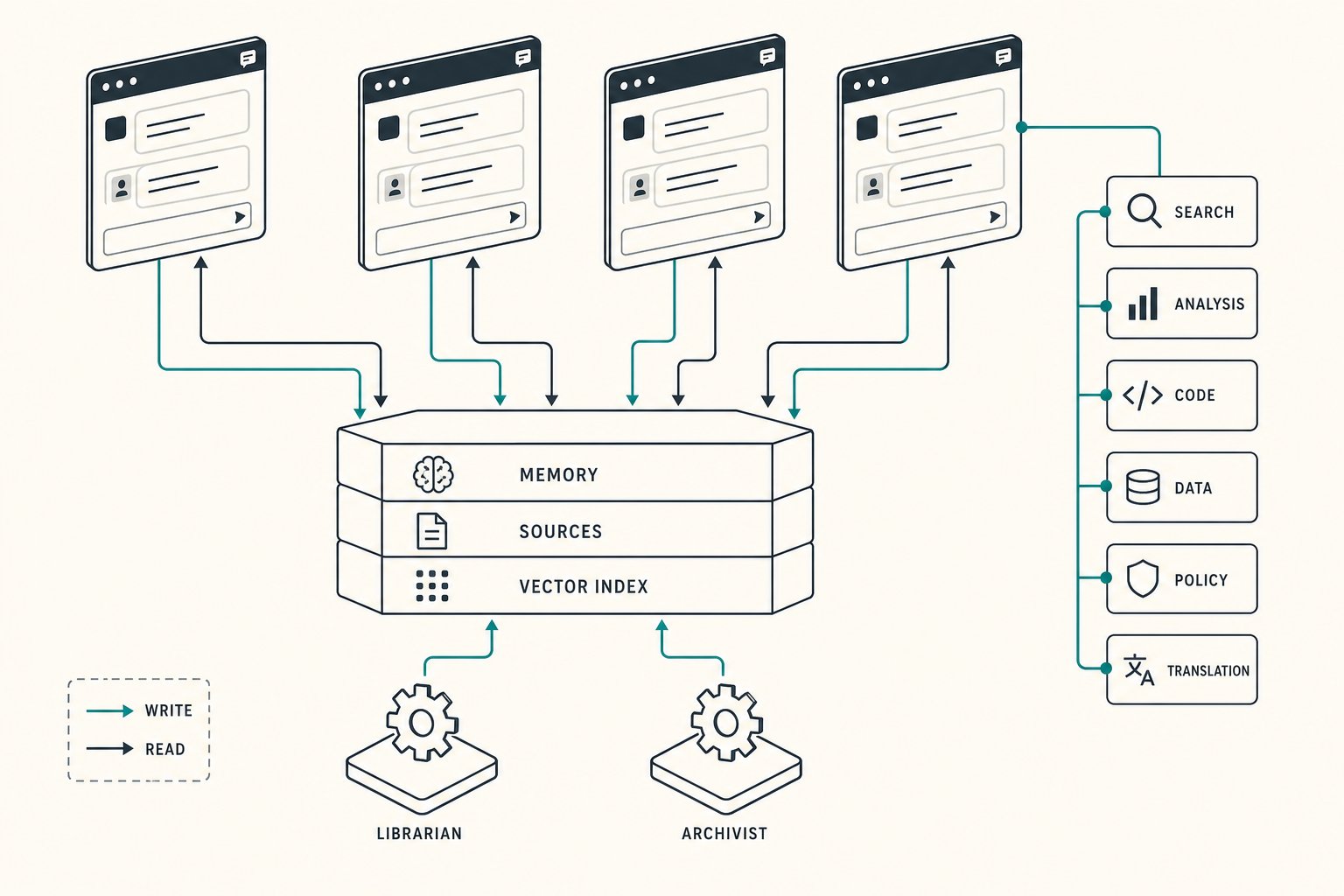
- Many conversations, one memory. I can run several conversations side by side, one for engineering, one for business, one for a particular client, each focused on its own work but all drawing on the same shared memory. None of them has to be told what the others already know.
- It reads up before it answers. Before I even see my own message land, the assistant has already searched its memory for whatever is relevant and pulled it into view, with a short note on why each piece matters. The context arrives with the answer instead of after a round of questions.
- It has a subconscious. While I work, a set of quiet background processes read what just happened and decide what is worth keeping, where it belongs, and what to discard. It works the way a human mind does after the fact. The conversation moves on, and underneath, the day's work is being sorted into long-term memory. You could say the assistant is dreaming. You never watch it happen. You just notice that next time you need something, it is already there.
- It can take on a specialist's hat. The assistant can switch into focused modes for particular jobs, a careful code reviewer, a researcher, a writer, an image-maker, each with its own discipline and tools. Heavy work can be handed off to run in the background while the main conversation keeps going.
- It clones for a client. The whole thing is a template. In a single step I can stand up a fresh assistant with its own identity, its own memory, and its own specialist modes for a client's world. Improvements I make to the core reach every copy automatically.
The hard parts
What made this real engineering.
Holding the thread over a long conversation. The longer a conversation runs, the more the early details blur, and the assistant cannot feel that happening. The fix is a small running notepad for each conversation that is shown back in full on every turn, so the decisions that matter stay sharp no matter how long the work goes on.
Getting the background sorting right. Tune it to keep too much and the memory fills with noise. Tune it to keep too little and it forgets what mattered. Striking that balance, and leaving a way to correct it when it gets the call wrong, took longer than the rest of the system put together.
Handing off work cleanly. Letting the assistant spin up helpers that run on their own, finish, and can be picked back up later without losing their place was the difference between useful background work and a mess of half-finished tasks.
One place to search, two kinds of knowledge. What the assistant writes for itself changes over time. The source documents it is given stay fixed. Keeping those apart, while still searching both with a single question, is a quiet design decision that pays back every day.
Why it matters
A working tool, and a starting point.
Orbit is the tool I work in every day and the foundation under every other engagement I run. It is also flexible enough that I rarely reach for anything else. Point it at a new kind of problem and it adapts.
It is the same thing I propose when a client wants an assistant of their own. Not a chat window bolted onto their data, but a real working partner that remembers, sorts its own knowledge, and takes on the specific shape of their work. From there it can stay a personal assistant, or become the base of something much more powerful. For example, the same approach can put a company's own network or documents behind a plain conversation that remembers what was said about them months ago.